
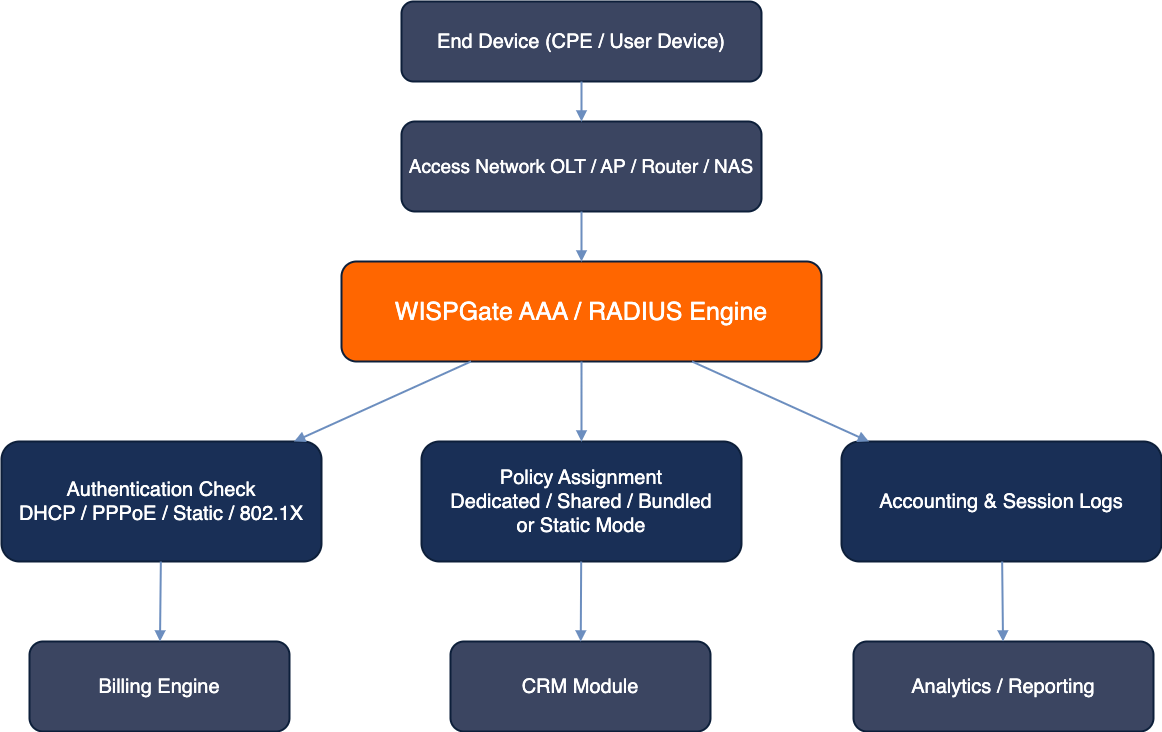
WISPGate AAA RADIUS Architecture Diagram
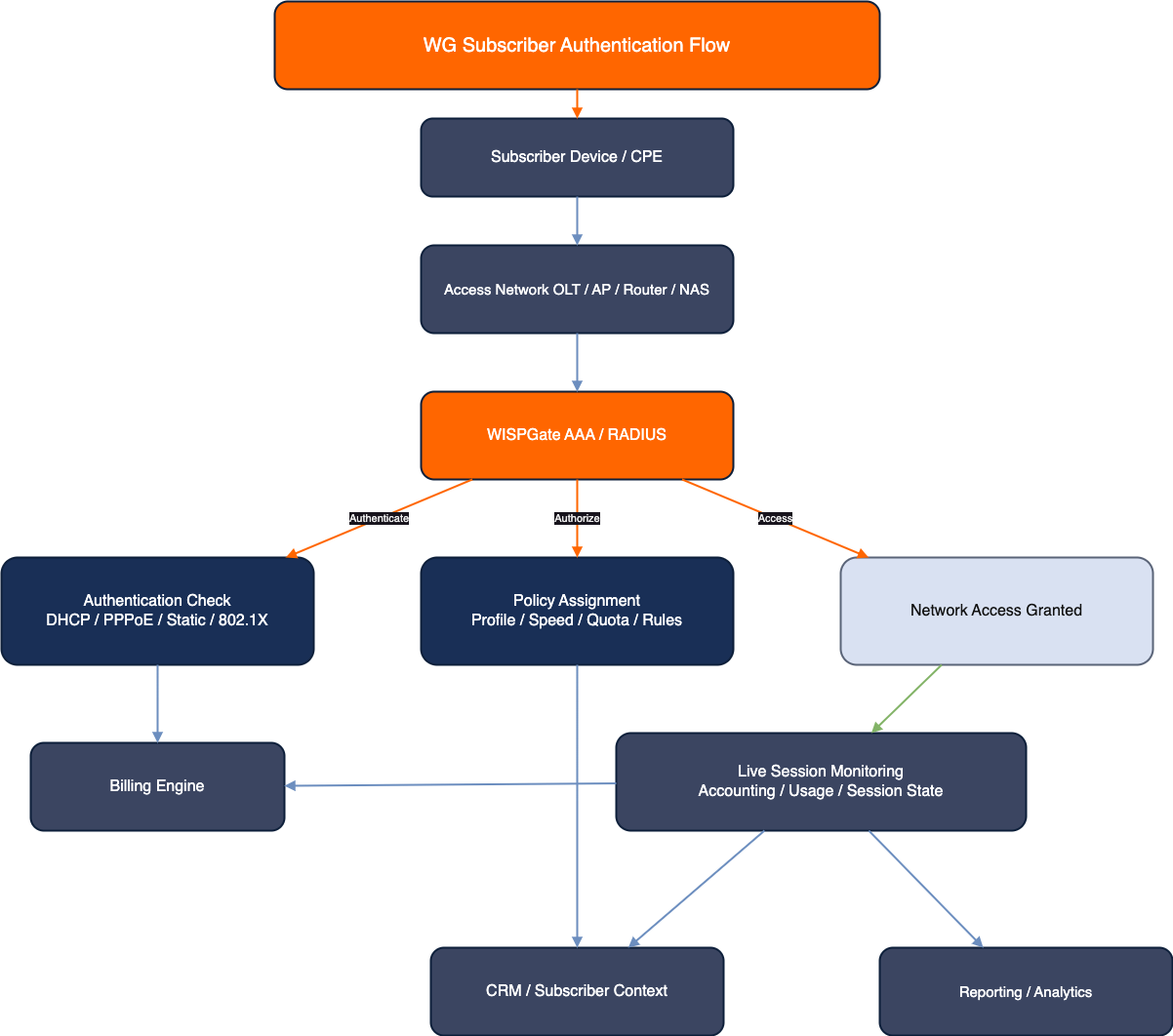
WISPGate Subscriber Authentication Flow Diagram
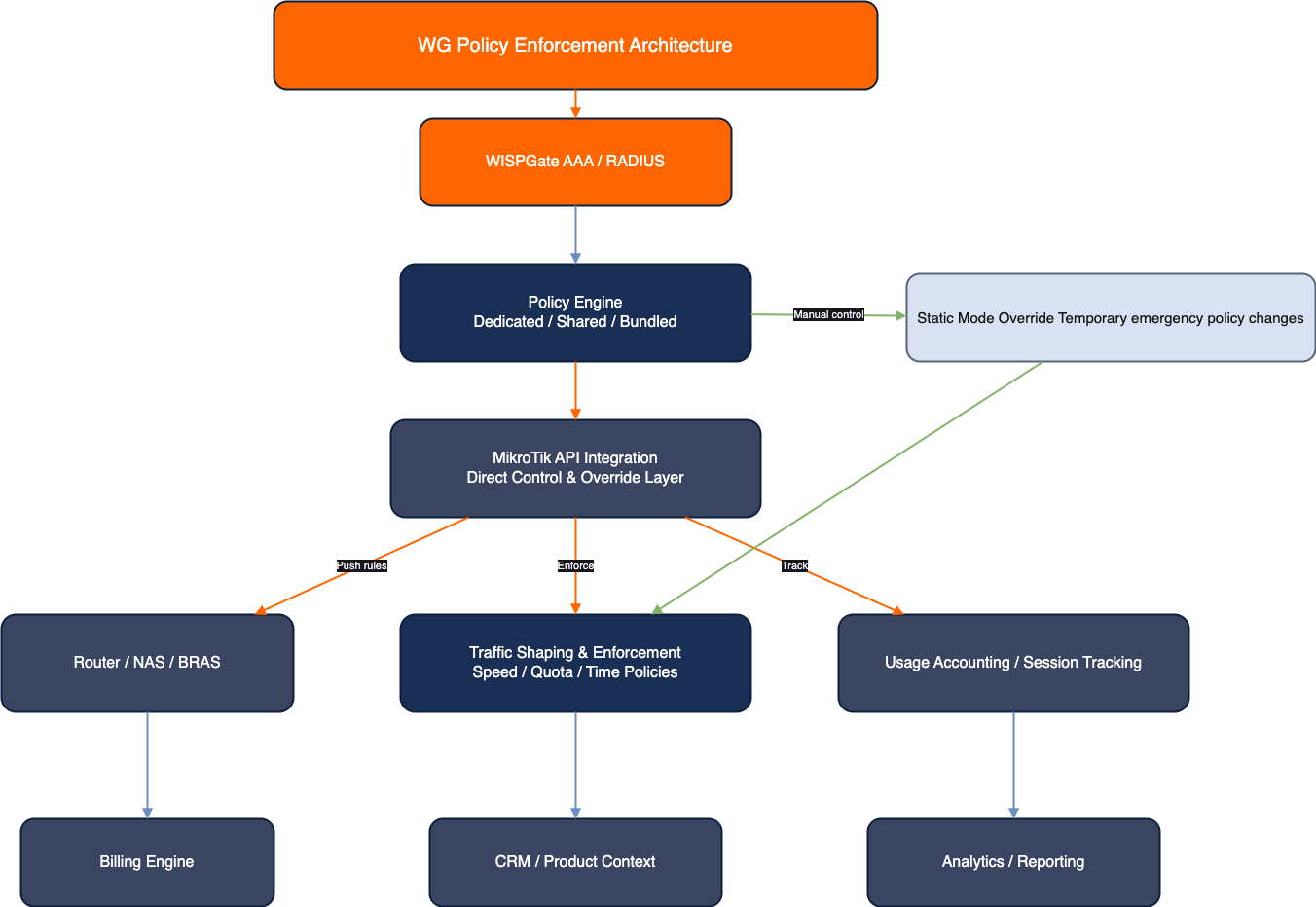
WISPGate Policy Enforcement Architecture Diagram
WISPGate can authenticate across multiple network environments:
Operators can define custom RADIUS dictionaries to match specialized hardware.
This ensures real-time financial and operational visibility.
Standard RADIUS deployments are limited to profile-based enforcement.
WISPGate goes further using MikroTik API integration.
Standard RADIUS logic:
WISPGate Enhancement:
Example:
Family Plan 200GB:
Useful for:
Allows dynamic switching of bandwidth/data limits based on time schedules.
| Time Window | Speed Limit |
|---|---|
| 08:00–18:00 | 10 Mbps |
| 18:00–00:00 | 50 Mbps |
| Weekend | Unlimited |
This allows:
Policy switching occurs automatically based on scheduler rules.
Static Mode allows administrators to temporarily override bandwidth policies manually.
Example Scenarios:
Unlike automated policies, Static Mode is direct and immediate—ideal for operational control during emergencies.
User Connects
   │
Authentication Check
   │
Subscriber Status Valid?
   │
Yes → Assign Policy Profile
   │
Check Special Conditions:
   │
   ├── Dedicated Package?
   ├── Shared Package?
   ├── Bundled Schedule?
   ├── Static Mode Active?
   │
Apply Final Policy
   │
Session Accounting Started
AAA does not operate in isolation.
This removes manual router configuration and human error.
Company: TechCorp Ltd.
WISPGate handles:
Fiber cut in Region A.
Admin activates:
Once issue resolved:
Normal policies restored automatically.
Most systems provide basic RADIUS authentication.
WISPGate provides:
This transforms AAA from a simple authentication layer into a policy orchestration and revenue enforcement engine tightly coupled with billing and service lifecycle management.