WISPGate Billing Engine

Carrier-Grade,
MDU-Ready Revenue Architecture

1. Overview

WISPGate’s Billing Engine is built specifically for ISPs, WISPs, FTTx operators, and mobile/VoIP providers operating in MDU (Multi-Dwelling Unit) and multi-service environments.

Unlike basic billing tools that assume one customer = one service, WISPGate is designed around a layered subscriber model:

  • 1 Subscriber (Contact and Organization)
  • Multiple Sub-Services
  • Each Sub-Service = 1 Main Service + Optional Add-Ons + Billable CPEs

The billing engine processes charges at the Sub-Service level, while maintaining financial aggregation at the Subscriber level, enabling maximum operational flexibility without revenue confusion.

The platform supports three advanced billing models to match diverse operational strategies.

  1. With Cycle-Based Billing, services are invoiced based on their activation anniversary (monthly, quarterly, annually, etc.), ensuring predictable recurring revenue.
  2. The Pro-Rata Billing model intelligently calculates charges from the activation date to the next defined billing cycle, after which the service automatically transitions into standard recurring cycles.
  3. For operators managing mixed policies across regions, PoP sites, or customer categories, Hybrid Billing allows both cycle-based and pro-rata logic to operate simultaneously within the same system.

Within pro-rata scenarios, WISPGate further enhances flexibility by offering two invoicing structures:

  • Independent Invoicing, where each subscribed service generates its own invoice,
  • Merged Invoicing, where multiple services under the same subscriber are consolidated into a single unified invoice for simplified accounting and customer experience.

This architecture gives operators complete control over revenue timing, regional policies, and customer segmentation — without operational complexity.
2. Billing Architecture

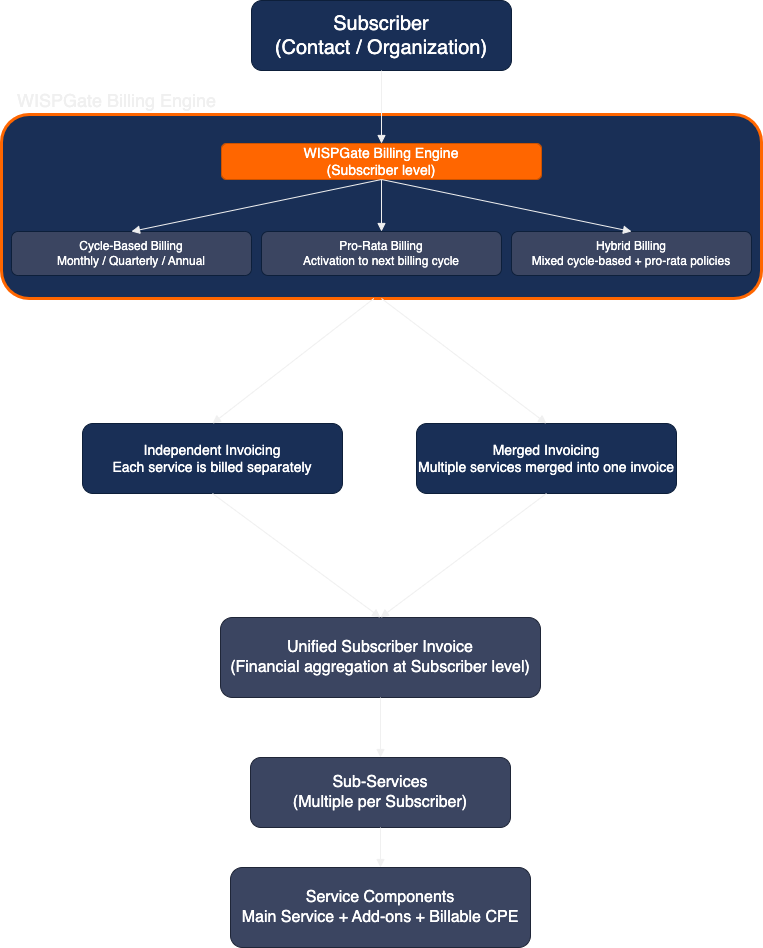
WISPGate Billing Architecture
Logical model: Subscriber-level financial aggregation with multi-service support

Key Design Principle

The default billing method (Cycle-Based) is applied at the Sub-Service level, while Pro-Rata billing logic in WISPGate operates at the Subscriber level.

Invoice logic can then either:

  • Keep services separate
  • Or merge them under one subscriber invoice

This allows:

  • Per-apartment billing
  • Per-unit isolation
  • Corporate account aggregation
  • Mixed residential + business services

3. Core Billing Models

3.1 Cycle-Based Billing

The billing date is based on the Sub-Service's activation anniversary.

Example:
  • Internet activated: March 10
  • Billing cycle: Monthly
  • Invoices: April 10, May 10, June 10

Best For: Residential fixed billing, predictable recurring revenue, stable subscriber base.

3.2 Pro-Rata Billing

Charges are calculated from the activation date until the next defined billing cycle date. After the first term, billing becomes regular cycle-based.

Example:
  • Global billing date: 1st of each month
  • Internet activated: March 18
  • March 18 → March 31 = Pro-rated charge
  • From April 1 onward = Full recurring cycle

This avoids revenue leakage and ensures fairness.

3.3 Hybrid Billing

Hybrid allows mixing models across:

  • Regions
  • PoP sites
  • Subscriber types
  • Service categories
  • Enterprise vs Residential
Example:
  • Residential Internet → Cycle-Based
  • Business Fiber → Pro-Rata
  • IPTV → Always 1st of month
  • VoIP → Anniversary-based

All coexisting in the same environment.

4. Invoicing Logic (Pro-Rata Scenario)

Within Pro-Rata billing, WISPGate supports two invoicing strategies:

4.1 Independent Invoicing

Each Sub-Service generates its own invoice.

Example:

Subscriber has:

  • Internet
  • IPTV
  • VoIP

→ 3 Separate invoices.

Useful for:

  • Departmental accounting
  • Enterprise customers
  • Unit-level separation in MDUs

4.2 Merged Invoicing

All Sub-Services under the same Subscriber are consolidated into one invoice.

Example:

Subscriber total:

  • Internet: $40
  • IPTV: $15
  • VoIP: $10

→ Single invoice: $65

Best for:

  • Residential customers
  • Simplified payment tracking
  • Reduced accounting friction

5. Charge Components Inside a Sub-Service

Each Sub-Service contains:

5.1 Main Service (Mandatory)

One of:

  • Internet
  • IPTV
  • VoIP

This defines:

  • Recurring base fee
  • Billing cycle logic
  • Service suspension rules

5.2 Additional Services (Optional)

Examples:

  • Print-on-demand
  • Installation fee
  • Public IP
  • Premium channel
  • Extra bandwidth boost

5.3 Billable CPEs & Devices (Optional)

Examples:

  • ONU
  • WiFi Router
  • Set-Top Box
  • VoIP ATA
  • LTE CPE

6. Accounting Types (Applied to Add-Ons & CPEs)

Both Additional Services and CPEs support three accounting modes:

6.1 One-Off

Charged once.

Example: Installation Fee: $100 (one-time)

6.2 Recurring

Charged every billing cycle.

Example: Public IP: $5/month
Router rental: $3/month

6.3 Installment (X Times)

Split into a defined number of billing cycles.
Example: Router price: $120
12 installments
→ $10/month for 12 months
After completion:
The charge automatically stops.
The device can remain active.

7. Billing Calculation Flow

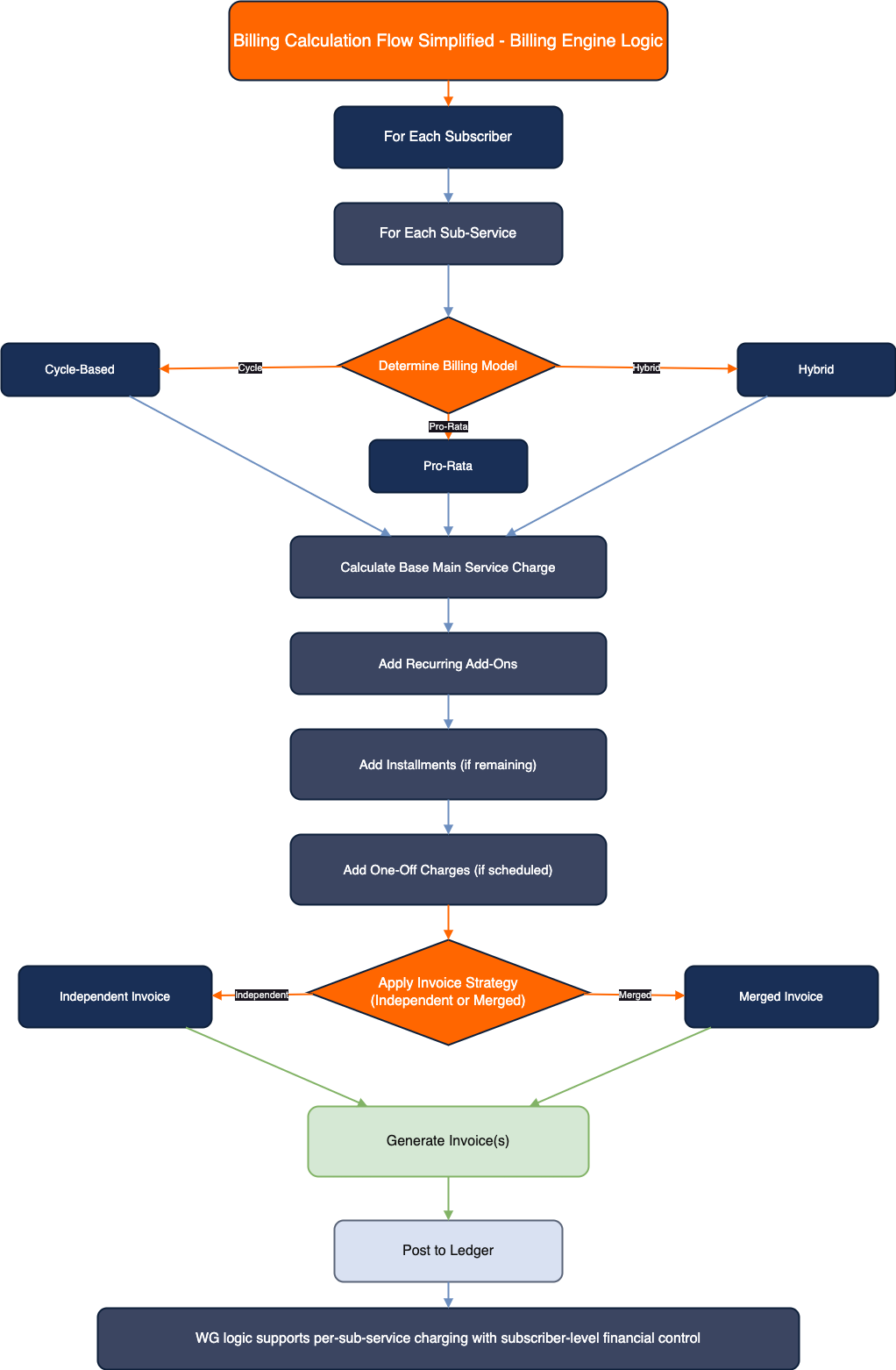
Billing Calculation Flow
Billing engine logic: cycle-based, pro-rata, and hybrid calculation paths
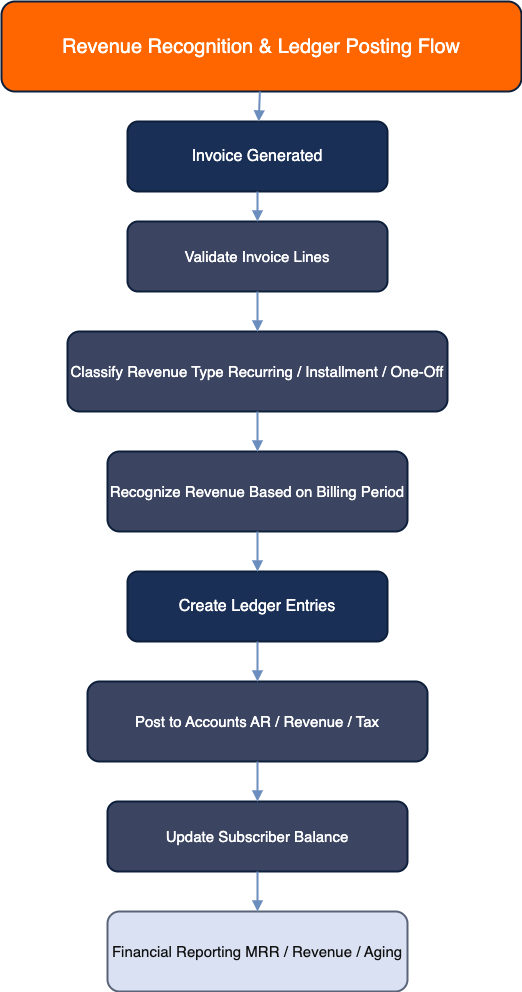
Revenue Recognition & Ledger Posting
Automated revenue recognition based on billing period with GL posting

8. Real-World Example (MDU Scenario)

Building Account (Organization Subscriber)

Subscriber: GreenTower Apartments

Units:
Apt 101 → Internet 100 Mbps
Apt 102 → Internet + IPTV
Office → VoIP + Public IP

Billing Model:
Residential → Cycle-Based
Office → Pro-Rata
Invoice Mode → Merged per unit

Results:
Apt 101 receives 1 invoice
Apt 102 receives 1 invoice
Office receives separate invoice
All under same organization master account

9. Why This Matters for Operators

WISPGate's billing engine eliminates common ISP pain points:

✔ Supports complex MDU structures
✔ Prevents cross-unit billing confusion
✔ Allows granular charge control
✔ Enables hardware financing (installments)
✔ Handles hybrid regional policies
✔ Supports enterprise-grade invoice consolidation
✔ Prevents revenue leakage in mid-cycle activations

10. Strategic Advantage

Most billing systems force operators into:

  • Single billing logic
  • Flat customer model
  • Weak installment handling
  • Manual invoice consolidation

WISPGate was architected for:

  • Multi-service subscribers
  • MDU deployments
  • Mixed residential/business portfolios
  • Hardware monetization
  • Flexible financial policy per region

The result is a fully modular, revenue-optimized billing framework capable of scaling from small WISPs to multi-region carriers without restructuring the financial core.