WISPGATE CRM

Unified Operational Control
for Service Providers

WISPGate CRM is not a generic contact manager. It is a fully integrated operational command center built specifically for ISPs, WISPs, FTTx operators, VoIP providers, and mobile network operators. It connects commercial, financial, operational, HR, and support functions into a single, synchronized ecosystem.
Unlike traditional CRMs that stop at sales tracking, WISPGate CRM manages the full service lifecycle β€” from lead acquisition to payroll, from ticket escalation to expense tracking.

1. System Architecture Overview

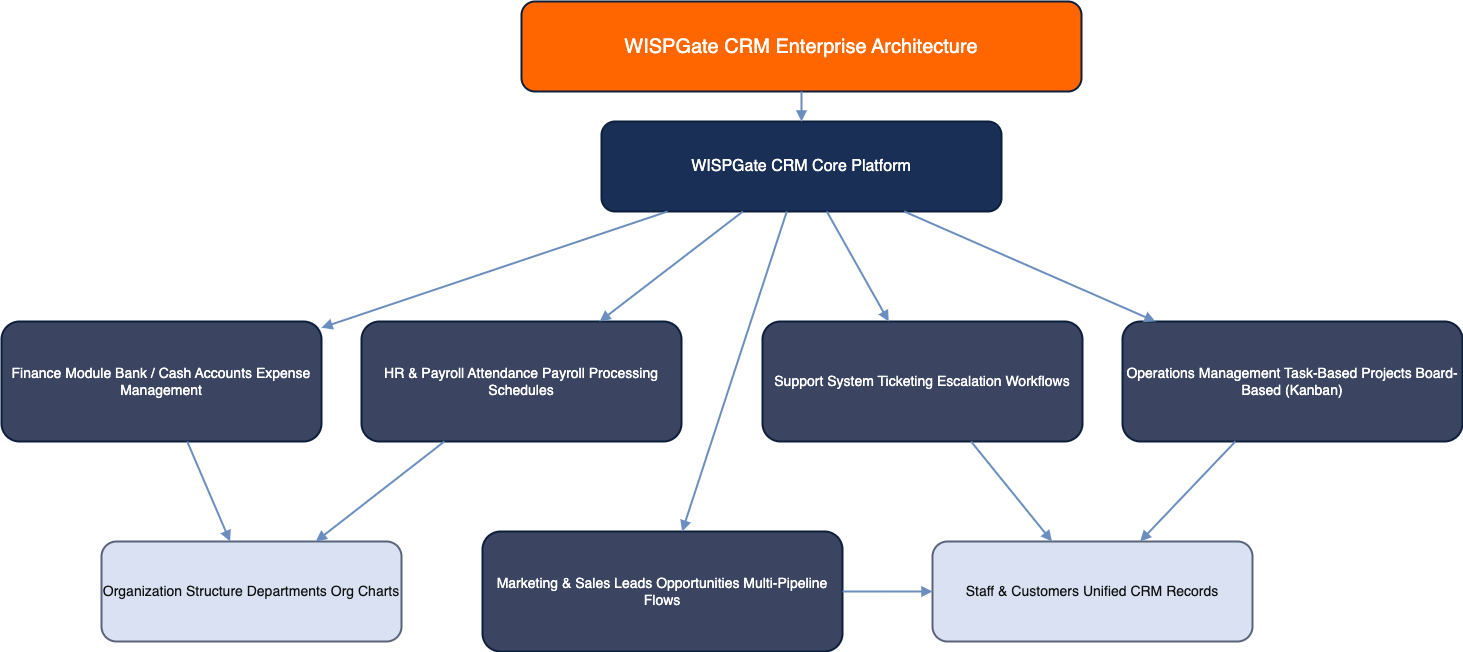
WISPGate CRM Architecture Diagram

Core CRM Modules

  • Finance Module
  • HR & Payroll
  • Support & Ticketing
  • Operations & Projects
  • Marketing & Sales
  • Organizational Structure

Each module operates independently but shares a unified data model, eliminating duplication and silos.

2. Finance Module

Purpose

To provide full internal financial visibility beyond customer billing.

Key Components

  • Multiple Account Management:
    • Bank Accounts
    • Cash Accounts
    • Petty Cash Accounts
  • Expense Tracking
  • Transaction Logs
  • Internal Transfers Between Accounts
  • Expense Categorization
  • Financial Reporting

Example Flow

  • Expense Recorded
  • ↓
  • Assigned to Account
  • ↓
  • Categorized
  • ↓
  • Posted to Ledger
  • ↓
  • Reflected in Financial Report

Example Use Case

Field engineer buys fiber cable.
Expense is recorded under:

  • Account: Petty Cash
  • Category: Infrastructure
  • Linked to: Project ID (optional)

Reflected in the monthly expense statement.

This creates financial discipline without external ERP dependency.
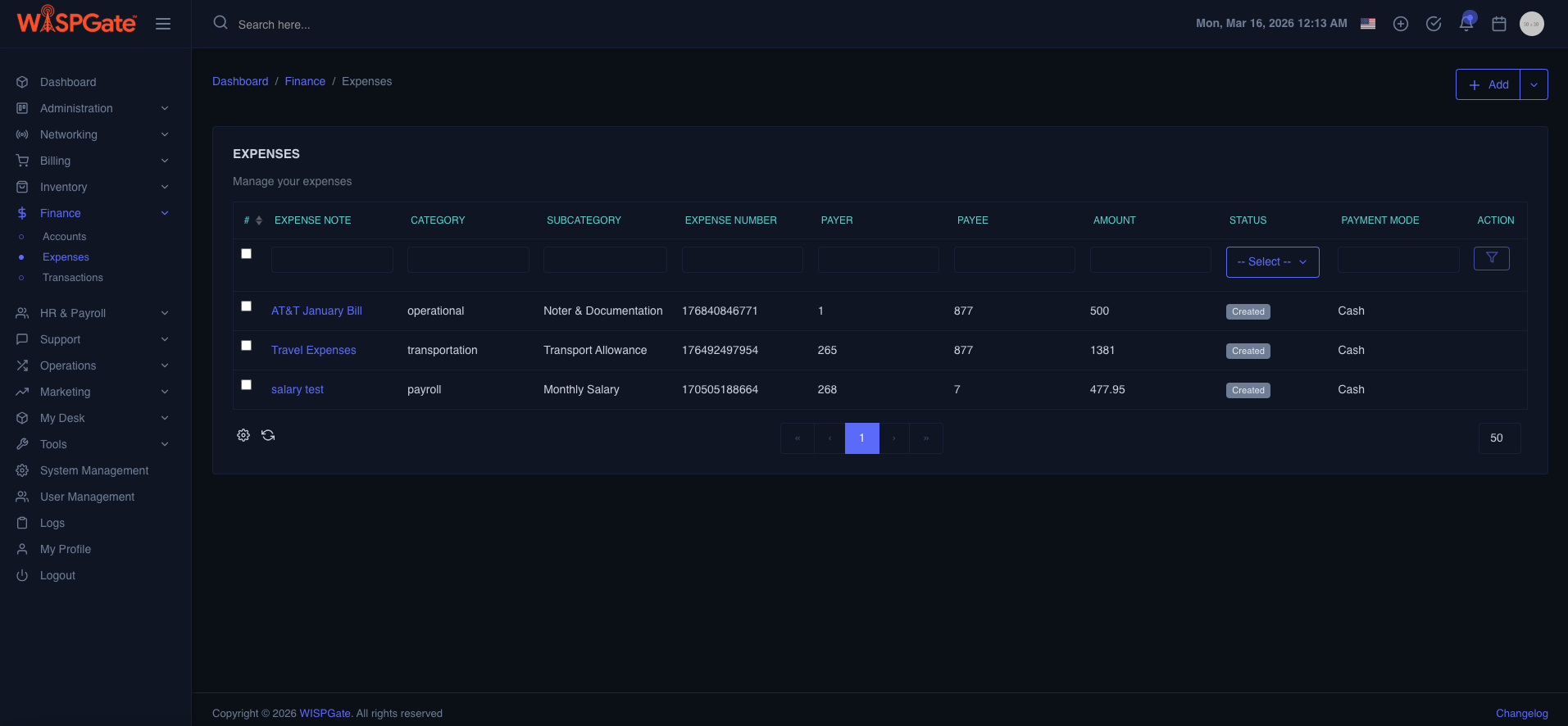
Expense Module Screenshot

3. HR & Payroll Module

Most CRMs ignore internal workforce management. WISPGate doesn't.

Core Capabilities

  • Employee Profiles
  • Attendance Tracking
  • Shift Scheduling
  • Payroll Processing
  • Payslip Generation
  • Salary Structures
  • Role & Department Assignment

Attendance Logic

  • Employee Check-in
  • ↓
  • Attendance Logged
  • ↓
  • Monthly Summary Generated
  • ↓
  • Payroll Calculated

Example

  • Tier-1 agent works 26 days
  • Attendance module calculates presence
  • Payroll auto-generates paycheck
  • Payslip downloadable
  • Linked to Finance module for salary disbursement tracking

This integrates workforce cost with operational analytics.
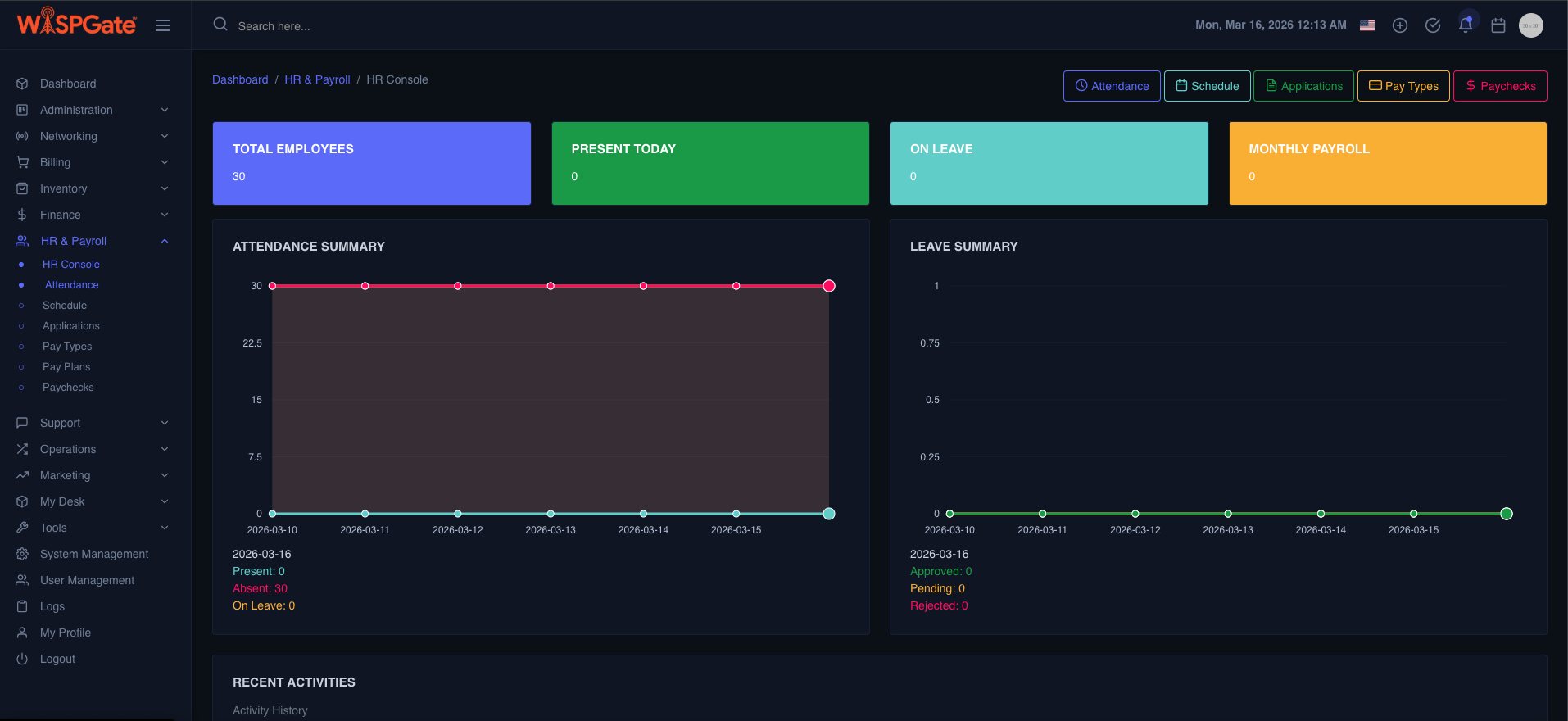
HR Console Screenshot

4. Support Module (Comprehensive Ticketing)

Support is deeply embedded into the CRM.

Core Features

  • Ticket Creation (Manual / Automated)
  • SLA Tracking
  • Escalation Levels
  • Priority Classification
  • Ticket Assignment
  • Linked Subscriber View
  • Internal Notes & Audit Trail
  • Status Workflow
  • Closure Confirmation

Ticket Lifecycle

  • Ticket Created
  • ↓
  • Assigned
  • ↓
  • SLA Countdown
  • ↓
  • Escalation (if required)
  • ↓
  • Resolution
  • ↓
  • Closure
  • ↓
  • Archived

Advanced Capabilities

  • Link tickets to
    • Subscriber
    • Sub-Service
    • Project
    • Device
  • Internal performance tracking
  • Escalation hierarchy (Tier 1 β†’ Tier 2 β†’ DevOps)

This transforms CRM into a real operational helpdesk.
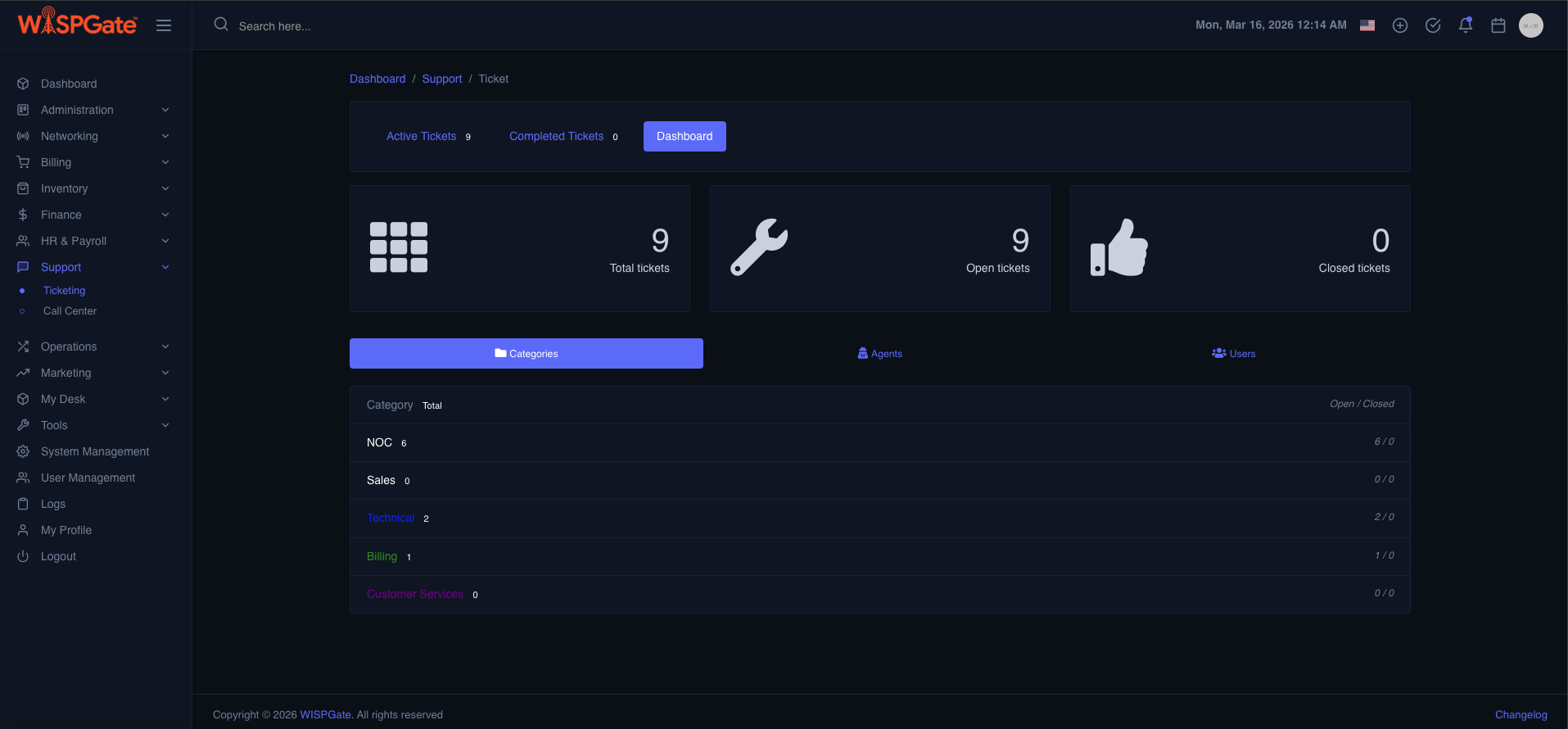
Ticketing Screenshot

5. Operations Module

Support is deeply embedded into the CRM.

Two Project Types:

Task-Based Projects

Structured execution model

Features

  • Task Assignment
  • Event Scheduling
  • Milestones
  • Deadlines
  • Shared Calendar
  • Responsible Team Members
  • Status Tracking

Example

Project: Fiber Rollout – Sector A

Tasks:

  • Survey Site
  • Deploy OLT
  • Install Distribution Cabinet
  • Test Links

Each task:

  • Assigned to engineer
  • Linked to event date
  • Visible in shared calendar

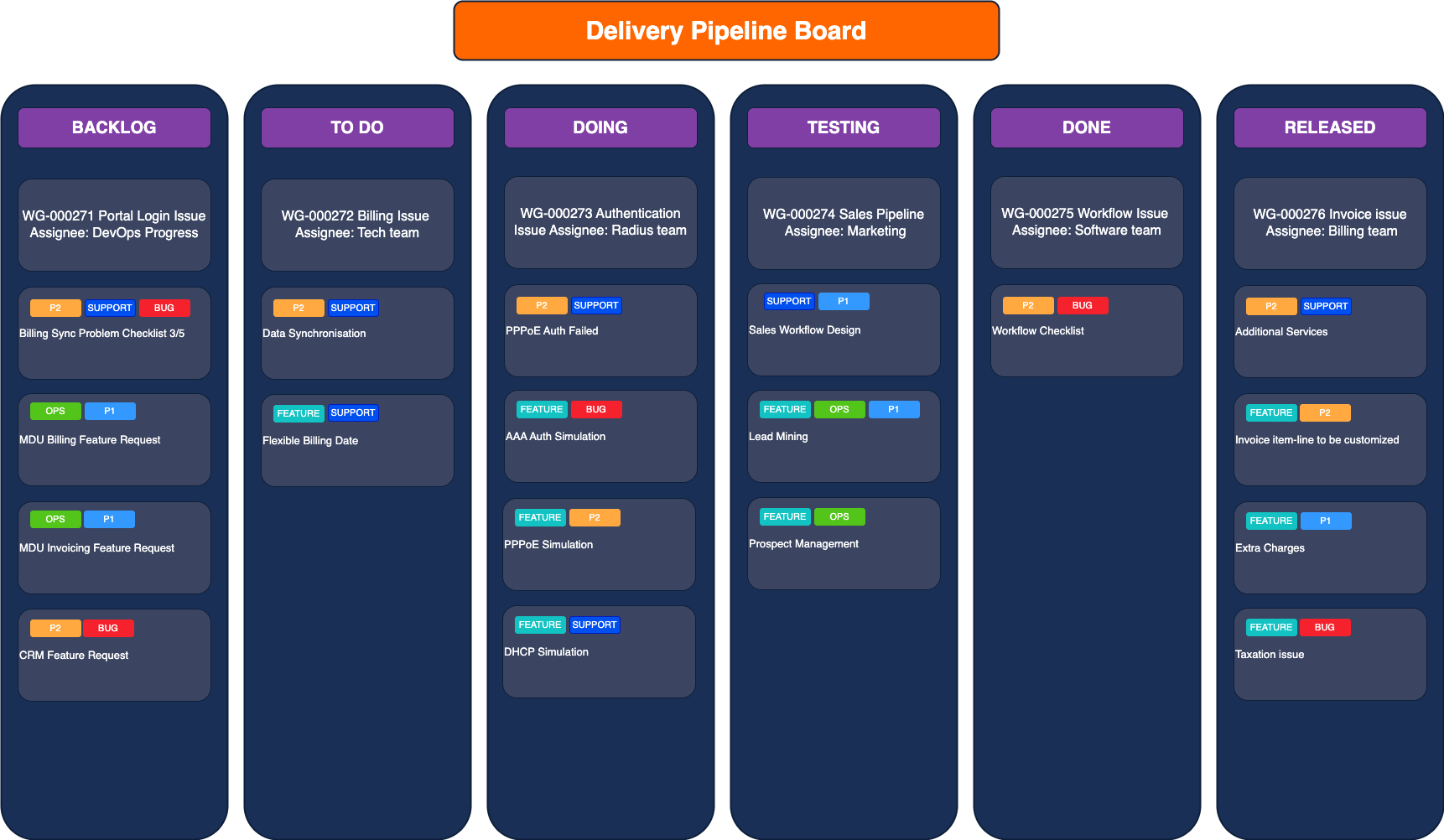
Board-Based Projects (Agile/Kanban Style)

This model is similar to Trello-style workflows.

Columns:

  • Backlog
  • In Progress
  • Review
  • Done

Each card:

  • Assigned
  • Commentable
  • Trackable
  • Time Stamped

Used for:

  • Development sprints
  • Marketing campaigns
  • Internal initiatives

This allows structured and agile management inside one system.
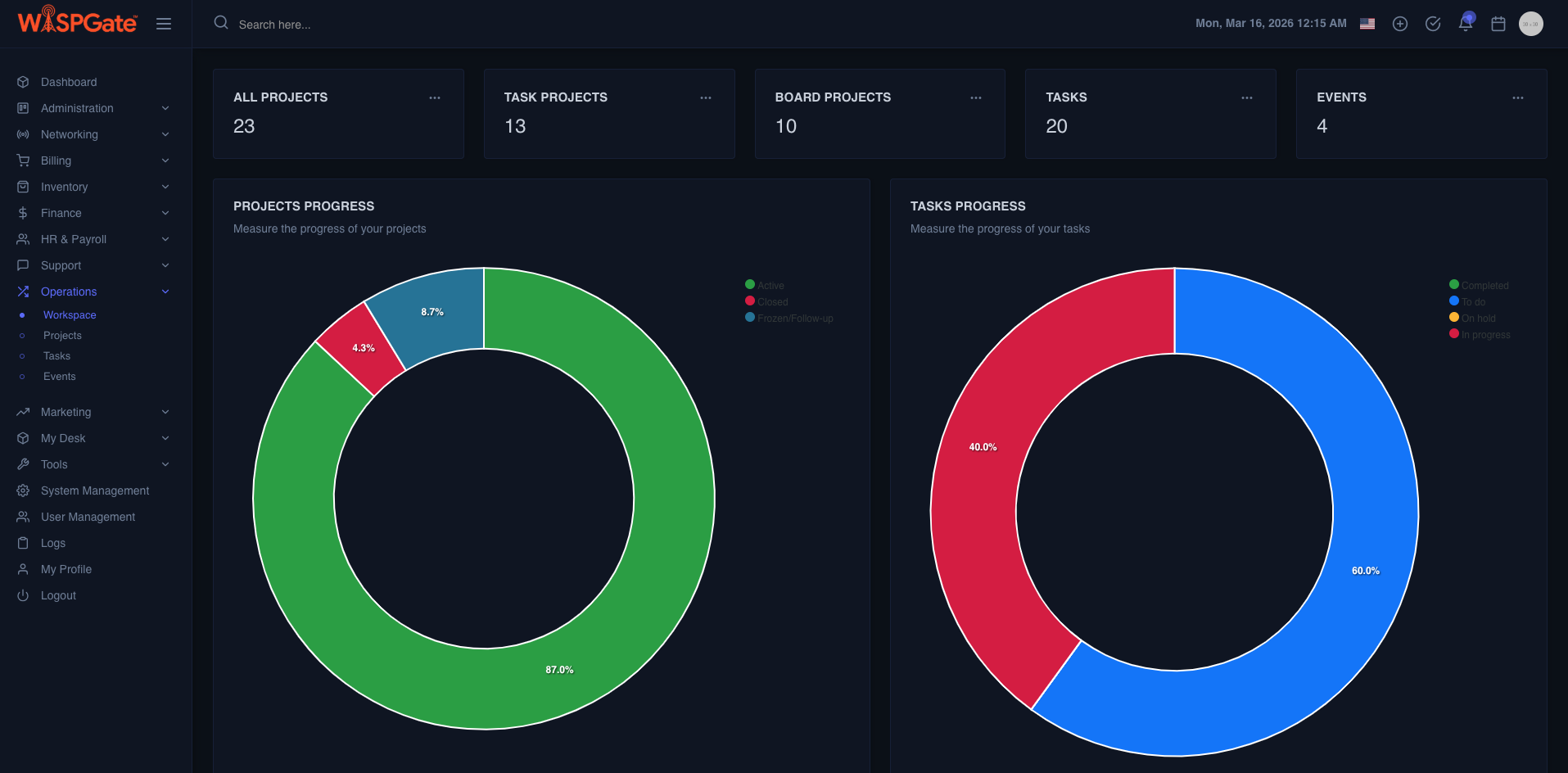
Workspace Screenshot Board-Based Diagram

6. Marketing & Sales Module

Designed for B2B and service-based sales cycles.

Core Capabilities

  • Lead Management
  • Opportunity Tracking
  • Custom Sales Pipelines
  • Multiple Pipeline Support
  • Stage Customization
  • Probability Forecasting
  • Deal Tracking
  • Sales Performance Monitoring

Custom Pipeline Example

  • Pipeline A – Enterprise ISP Sales:
    • Lead Captured
    • Discovery Call
    • Technical Evaluation
    • Proposal Sent
    • Negotiation
    • Closed-Won / Closed-Lost
  • Pipeline B – Residential Campaign:
    • Lead
    • Site Survey
    • Installation Scheduled
    • Activated

Multiple pipelines can run simultaneously across regions or business units.
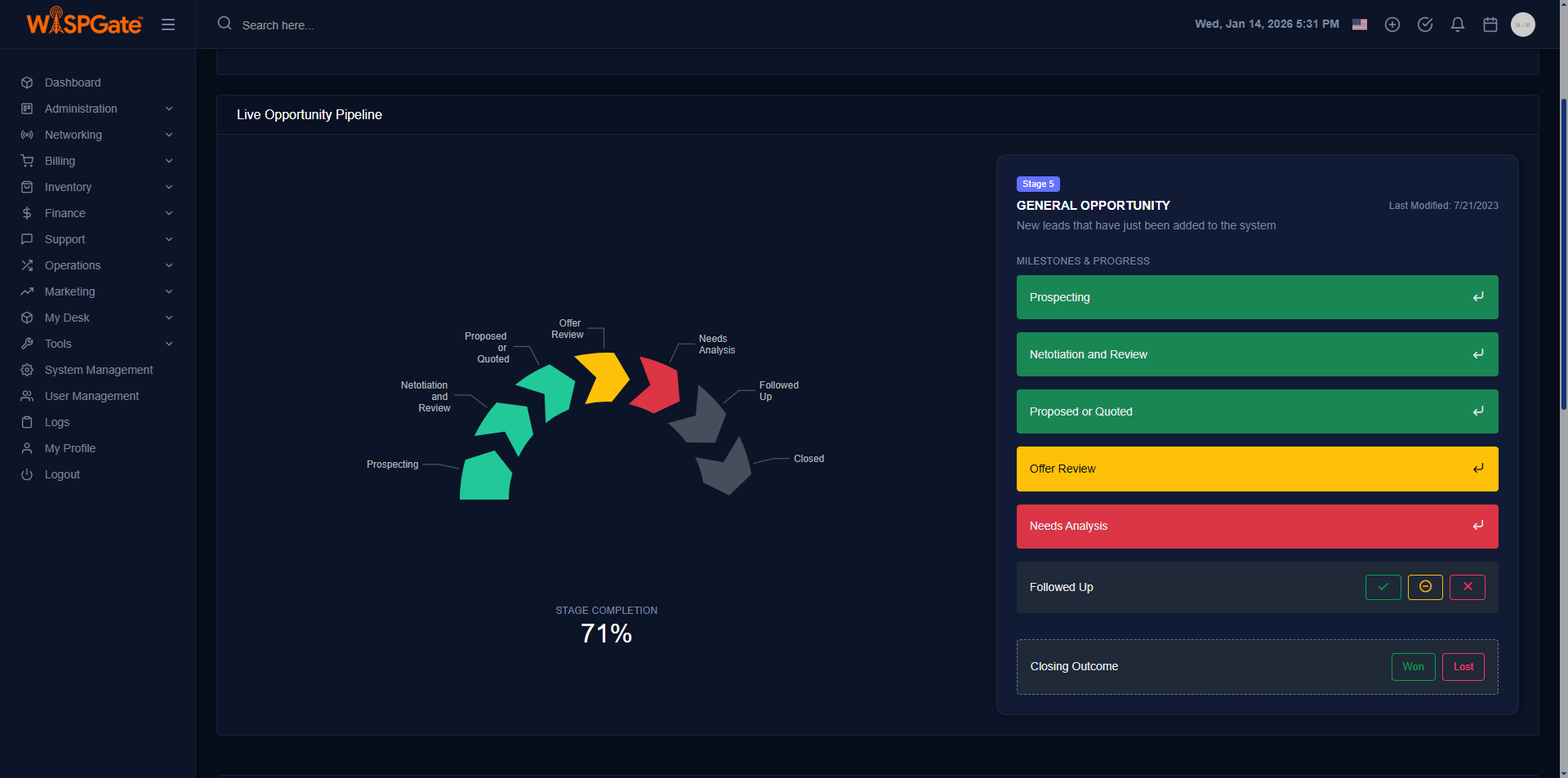
Opportunity Screenshot

7. Organizational Management

WISPGate CRM supports structured company hierarchy.

Features

  • Department Structure
  • Role Definitions
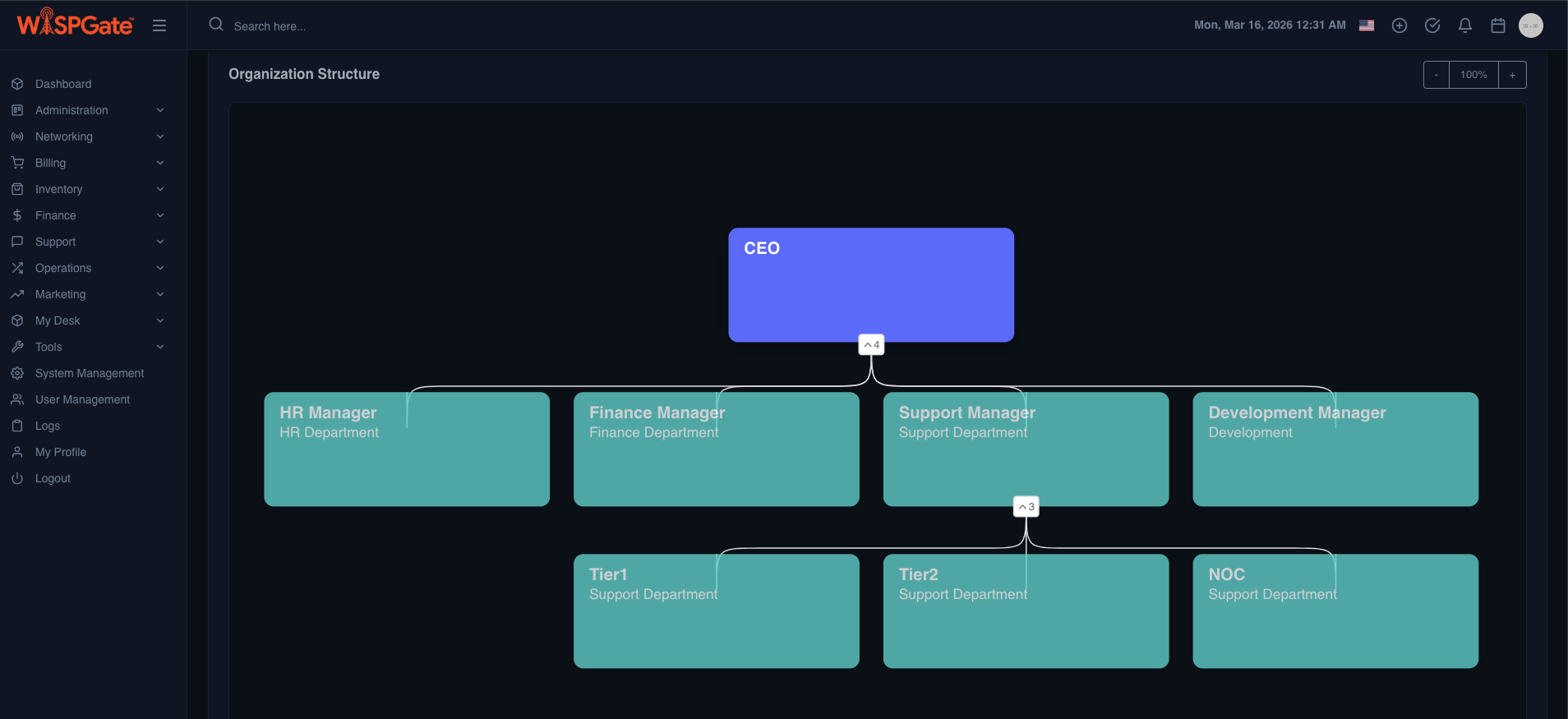
  • Organization Chart
  • Access Control
  • Permission Matrix

Example Structure

CEO
 β”œβ”€β”€ Finance Department
 β”œβ”€β”€ HR Department
 β”œβ”€β”€ Support Department
 β”‚     β”œβ”€β”€ Tier 1
 β”‚     β”œβ”€β”€ Tier 2
 β”‚     └── NOC
 └── Development
Organization Chart Screenshot

This controls data access and workflow authority.

8. Integrated Data Flow

One of the strongest advantages of WISPGate CRM is cross-module integration.

Example Scenario

  • Marketing captures a Lead
  • ↓
  • Lead becomes Opportunity
  • ↓
  • Opportunity becomes Subscriber
  • ↓
  • Subscriber gets Sub-Service
  • ↓
  • Billing activates
  • ↓
  • Support tickets link to subscriber
  • ↓
  • Project task created for installation
  • ↓
  • Expense logged for installation
  • ↓
  • Engineer payroll reflects attendance

All inside one unified system.
No data duplication. No external syncing.

9. Why This Matters for Operators

Most ISPs operate with:

  • Separate CRM
  • Separate HR software
  • Separate accounting tools
  • Separate ticketing systems
  • External project management tools

This creates:

  • Data fragmentation
  • Manual reconciliation
  • Operational blind spots
  • Accountability gaps

WISPGate CRM eliminates silos and centralizes:

  • βœ” Financial control
  • βœ” Workforce management
  • βœ” Operational planning
  • βœ” Sales visibility
  • βœ” Customer support
  • βœ” Project execution

All connected to the billing and service layer.

10. Strategic Positioning

WISPGate CRM is not just a CRM.

It is an Operational ERP for Telecom & Service Providers, purpose-built to integrate

  • Revenue
  • Operations
  • Workforce
  • Support
  • Sales
  • Financial Accountability

It scales from small ISPs to multi-region operators without architectural changes.