
WISPGate Integrations

Open Architecture. Unlimited Connectivity. Zero Lock-In.

WISPGate is built on an API-first, integration-driven architecture. It is designed to connect with virtually any external system that exposes an API or supports standard communication protocols. Whether financial, networking, messaging, analytics, or enterprise systems β€” WISPGate acts as the central orchestration hub.
This page explains:
  • βœ”What integrations WISPGate already supports
  • βœ”What integration capabilities it offers
  • βœ”How integrations technically work
  • βœ”Real operational workflows
  • βœ”Strategic advantages

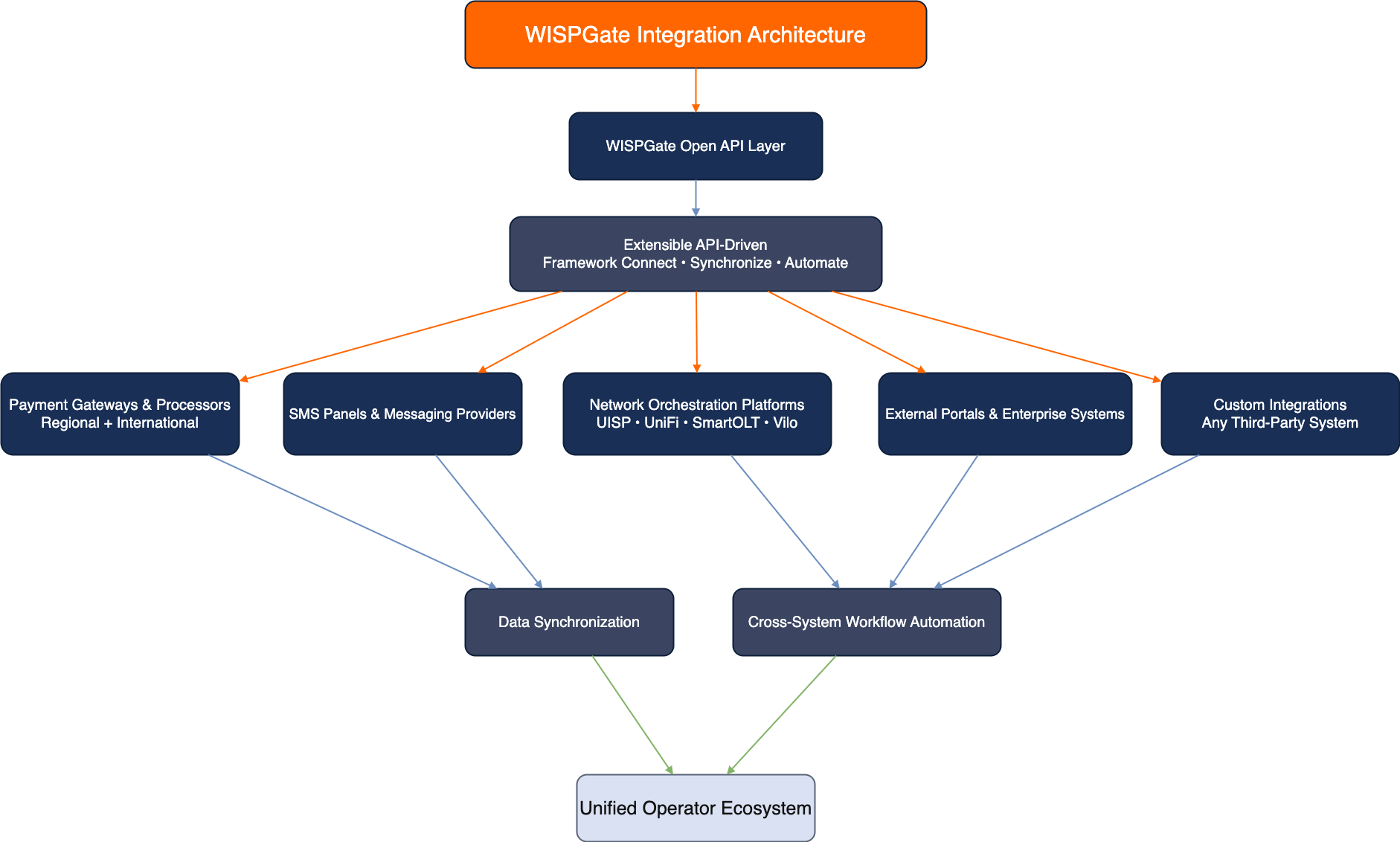
Integration Architecture Overview

WISPGate Integration Architecture Diagram

Logical Integration Model

External Systems Payment GW SMS Panel Network App Enterprise ERP/Portal WISPGate API Layer Billing CRM AAA OSS Inventory

WISPGate functions as:

  • API Client (consumes external APIs)
  • API Server (exposes its own RESTful API)
  • Event Trigger Source (via workflows)
  • Data Synchronization Hub

Payment Gateway & Financial Integrations

What We Already Support

WISPGate is integrated with dozens of:

  • Regional payment gateways
  • International processors
  • Bank virtual POS systems
  • Wallet providers
  • Payment aggregators
These integrations support:
  • Real-time payment confirmation
  • Auto-invoice settlement
  • Wallet balance top-ups
  • Recurring payments
  • Installment handling
  • Refund logic (if gateway supports)

Payment Flow Diagram

Customer Makes Payment
↓
Payment Gateway
↓ (Callback/Webhook)
WISPGate API Endpoint
↓
Invoice Marked Paid
↓
Service Status Updated (if previously suspended)
↓
Notification Sent (Email/SMS)

Example Workflow

Scenario: Overdue customer pays invoice.
  • Payment received via gateway.
  • Gateway sends webhook to WISPGate.
  • Invoice automatically marked paid.
  • Sub-service automatically reactivated.
  • RADIUS profile updated.
  • Customer receives confirmation SMS.
No manual finance or NOC intervention required.

SMS & Messaging Integrations

WISPGate integrates with multiple SMS panels and messaging providers.

Supported Use Cases

  • Invoice reminders
  • Outage alerts
  • OTP verification
  • Marketing campaigns
  • Payment confirmations
  • Installation notifications

Messaging Flow

Trigger Event (Invoice Generated / Device Offline)
↓
Notification Rule
↓
Select SMS Provider
↓
Send Message
↓
Log Delivery Status
Providers can be swapped or added without altering core architecture.

Network & Infrastructure Integrations

WISPGate integrates with major networking platforms and management tools.

Examples include:

  • UISP
  • UniFi Controller
  • SmartOLT
  • Vilo
  • MikroTik (RADIUS + API)
  • Other NAS platforms

Network Synchronization Model

WISPGate
↓ (API / RADIUS / SNMP)
Network Platform
↓
Device State / Subscriber Data
↓
Feedback to WISPGate (Usage, Status, Alerts)

What This Enables

  • Subscriber sync
  • Service provisioning
  • Speed policy enforcement
  • ONU authorization
  • Device monitoring
  • Automated suspension/reactivation

External System Integrations

Because WISPGate exposes its own API, it can integrate with:

  • Custom customer portals
  • Mobile apps
  • Enterprise ERP systems
  • Accounting software
  • Data warehouses
  • BI tools
  • Government systems (if required)

API Interaction Model

Outbound (WISPGate β†’ External)
Workflow Trigger
β†’
API Call
β†’
External System Updated
Example: New subscriber created β†’ Push to ERP system.
Inbound (External β†’ WISPGate)
External Event
β†’
API Call
β†’
WISPGate Update
Example: Mobile app payment β†’ Mark invoice paid.

Real-World Integration Workflows

Website Integration

Customer Signs Up on Website
↓
Website API β†’ WISPGate
↓
Subscriber Created
↓
Sub-Service Generated
↓
Workflow Creates Installation Task
WISPGate becomes the backend engine of the website.

Accounting System Sync

Invoice Generated
↓
API Push to Accounting Software
↓
Ledger Entry Created
↓
Payment Sync Back to WISPGate

Network Outage Notification

SNMP Alert from Network
↓
WISPGate Monitoring
↓
Trigger Workflow
↓
Send SMS via SMS Panel
↓
Create Ticket

Custom Integration Capability

WISPGate offers:

  • RESTful API endpoints
  • Webhook support
  • Token-based authentication
  • Modular API structure
  • Extensible custom fields

If a platform exposes an API, WISPGate can integrate.

Integration types supported:

  • REST
  • Webhooks
  • RADIUS
  • SNMP
  • NetFlow
  • TR-069
  • Direct API (vendor-specific)
  • File-based import/export (if required)

Integration Governance Model

Define Objective
↓
Identify External System API
↓
Map Data Fields
↓
Configure API Credentials
↓
Test in Sandbox
↓
Deploy to Production
↓
Monitor Logs

WISPGate maintains logging for:

  • API calls
  • Errors
  • Payload tracking
  • Status confirmation

Strategic Advantages

Most platforms:

  • Limit integrations
  • Charge extra per integration
  • Restrict API endpoints
  • Lock customers into proprietary ecosystems

WISPGate:

  • βœ” Open API-first architecture
  • βœ” Multi-gateway financial support
  • βœ” Multi-SMS provider flexibility
  • βœ” Deep network ecosystem integration
  • βœ” Bidirectional data synchronization
  • βœ” Workflow-triggered external calls
  • βœ” No ecosystem lock-in

What This Means for Operators

Integration is not about β€œconnecting tools.”
It is about:
  • Eliminating manual work
  • Preventing reconciliation errors
  • Ensuring real-time synchronization
  • Protecting revenue
  • Accelerating provisioning
  • Scaling without friction
WISPGate operates as the central nervous system of the ISP ecosystem β€” synchronizing finance, network, customer management, and external platforms in real time.