
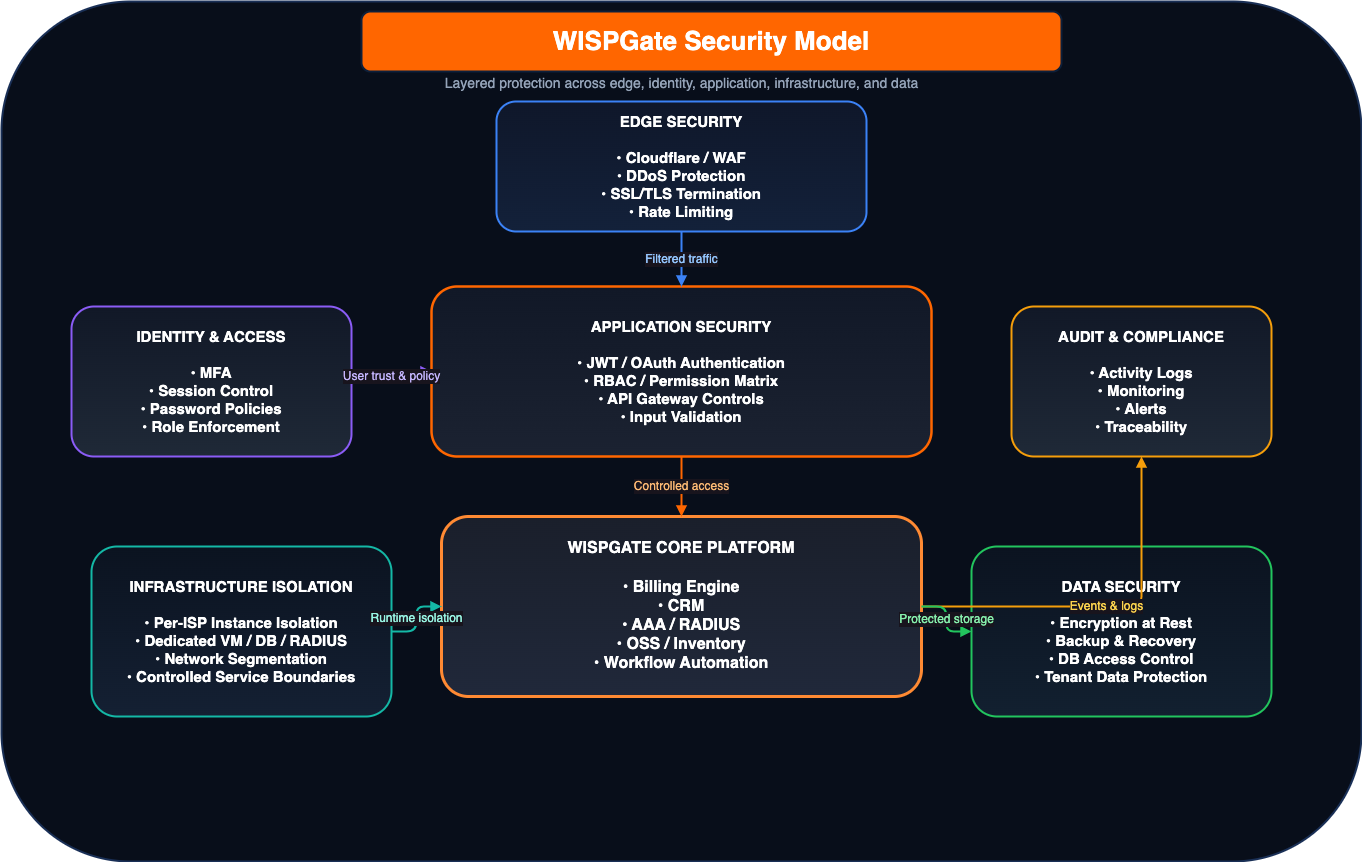
At the top, Edge Security acts as the first filtration layer, absorbing external threats before they even touch your system. WAF, DDoS protection, and TLS termination are positioned here intentionally to show that malicious traffic is neutralized at the perimeter, not handled internally.
This reduces the attack surface and protects downstream components from unnecessary load and exposure.
Moving inward, Identity & Access and Application Security form the enforcement layer. This is where most platforms fail—but your model makes a critical distinction: authentication (JWT/OAuth) is not enough.
Real control comes from RBAC, session policies, and API-level enforcement, ensuring that every request is validated not just for identity, but for intent and permission scope. This turns your application into a gatekeeper, not just a processor.
At the center, WISPGate Core Platform is not just protected—it is self-defending by design. Every module (Billing, CRM, AAA, OSS, Automation) operates under controlled access rules, with no direct, uncontrolled entry points. This reinforces the idea that security is embedded within the operational logic, not layered on top of it.
What sets this model apart—and what you should aggressively highlight—is the Infrastructure Isolation layer. Unlike shared SaaS systems, WISPGate isolates each ISP at the infrastructure level (dedicated VM, database, and RADIUS).
This means even in worst-case scenarios, blast radius is contained per tenant, eliminating cross-customer risk. This is not a feature—it’s a strategic advantage most competitors cannot replicate.
On the right, Audit & Compliance ensures full visibility. Every action, event, and anomaly is logged, monitored, and traceable.
This closes the loop: not just preventing attacks, but enabling accountability and forensic analysis.
Finally, at the bottom, Data Security guarantees that even if everything else fails, the data remains protected through encryption, controlled access, and reliable backup strategies.
If this diagram communicates one thing clearly, it’s this:
WISPGate doesn’t rely on a single security layer—it enforces security at every level: edge, identity, application, infrastructure, and data, with isolation as its strongest differentiator.
Learn how WISPGate’s multi-layered security model protects your operational core and subscriber data.
Explore the database structures, scalability, and API access layers that complete the WISPGate technical ecosystem.